
Single Finest, 1645 Charles I, Gold Oxford ‘Declaration Unite’, MS61
S. 2738 die combination XIII/19
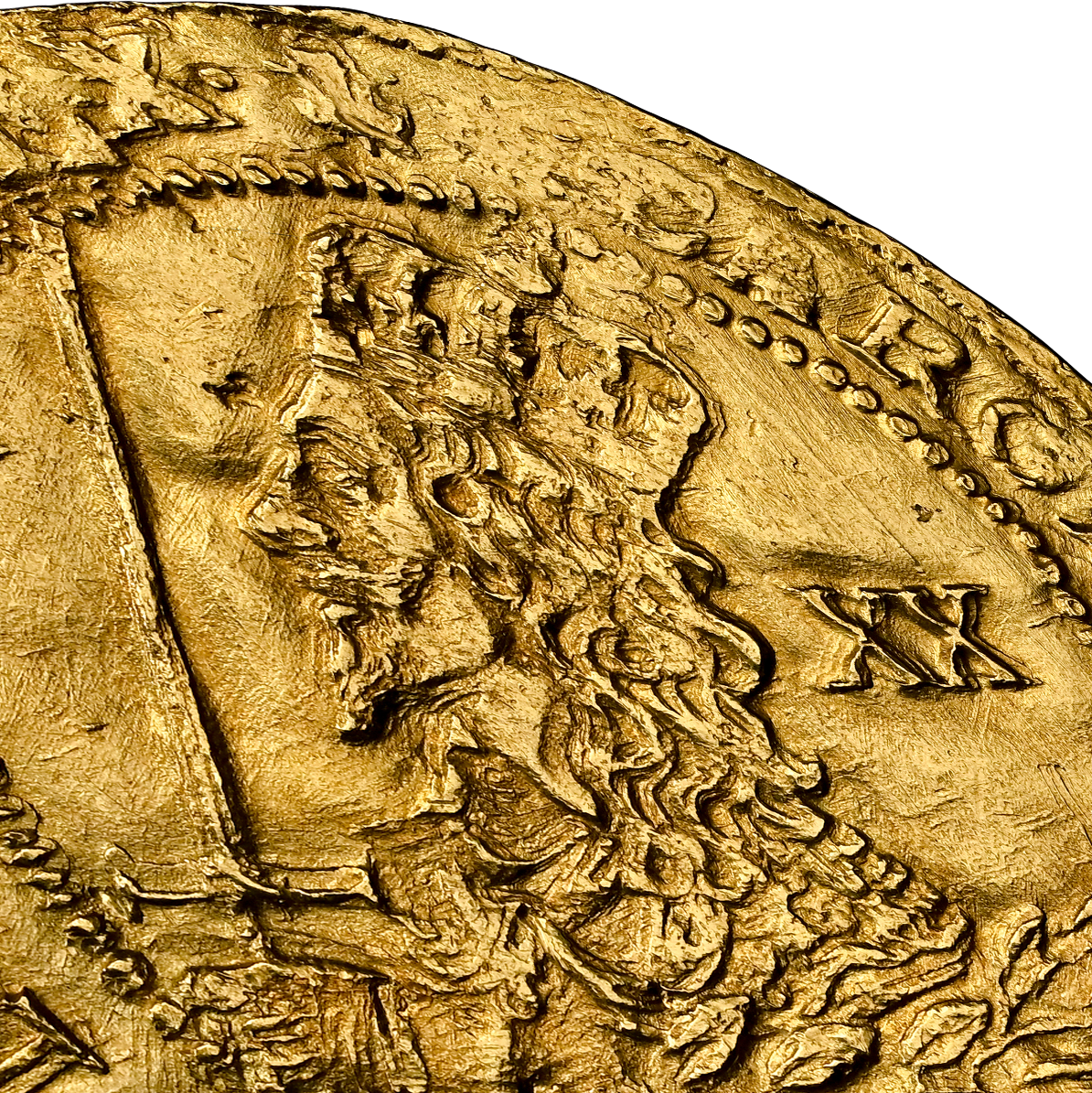
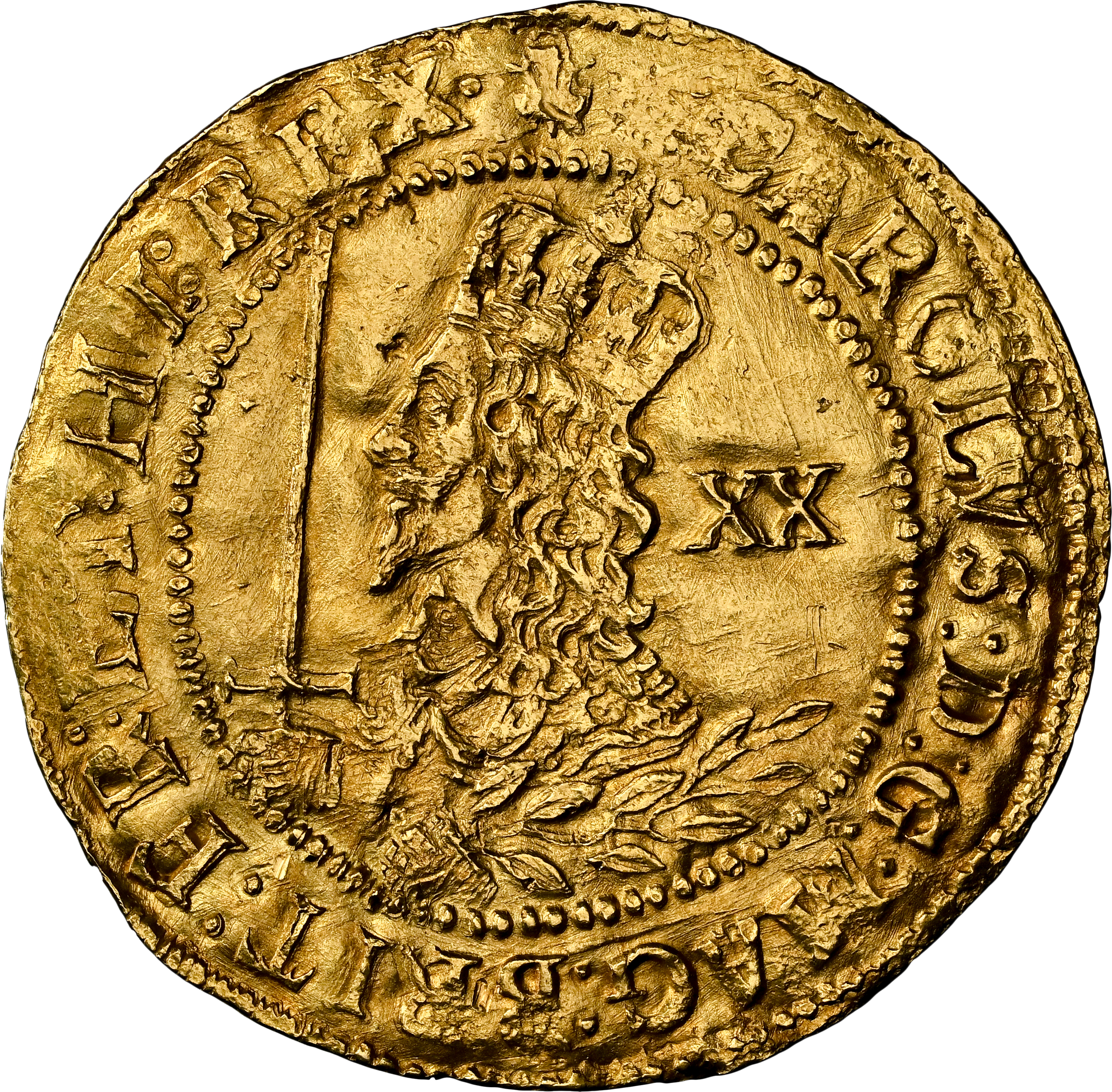
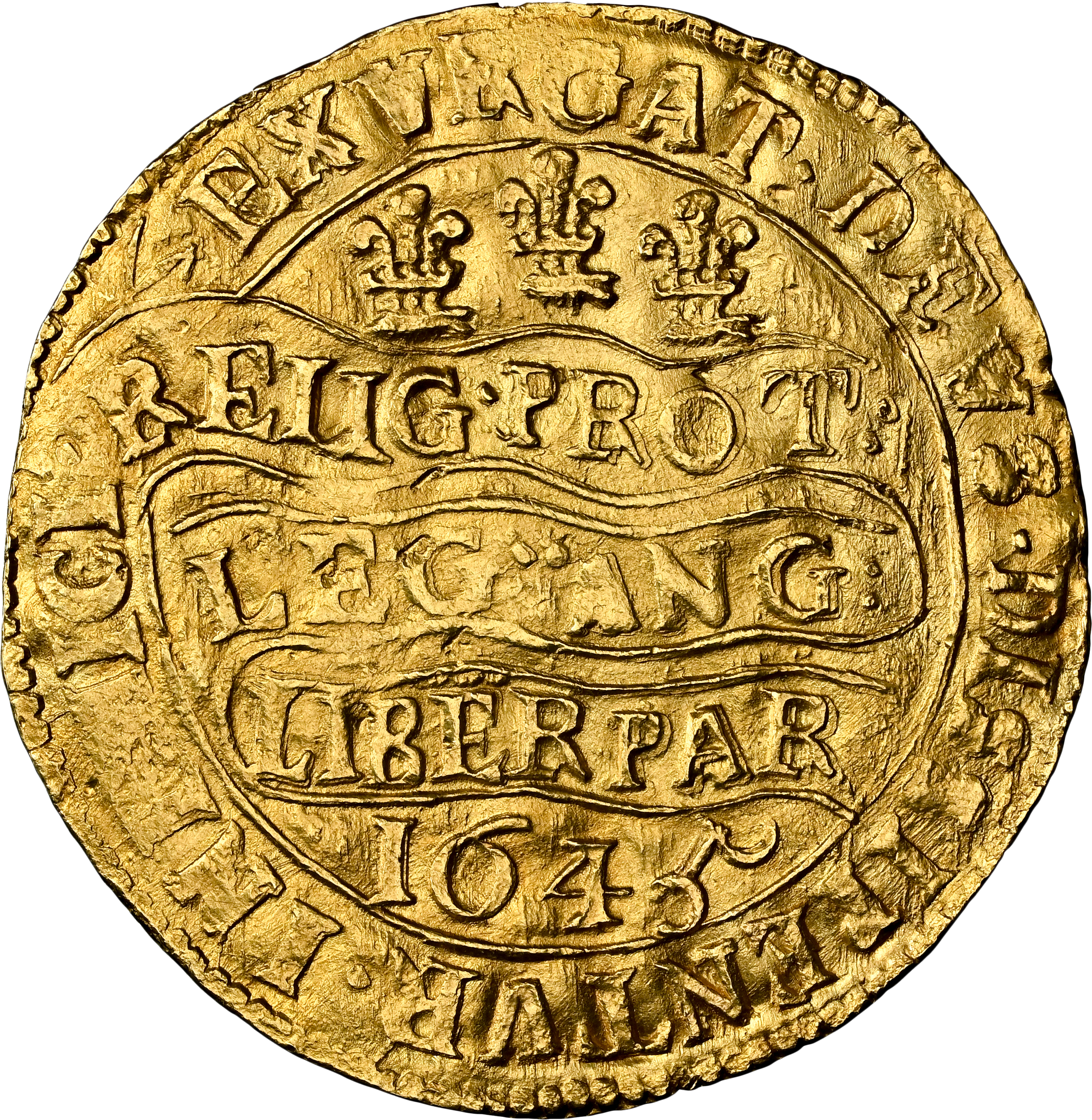
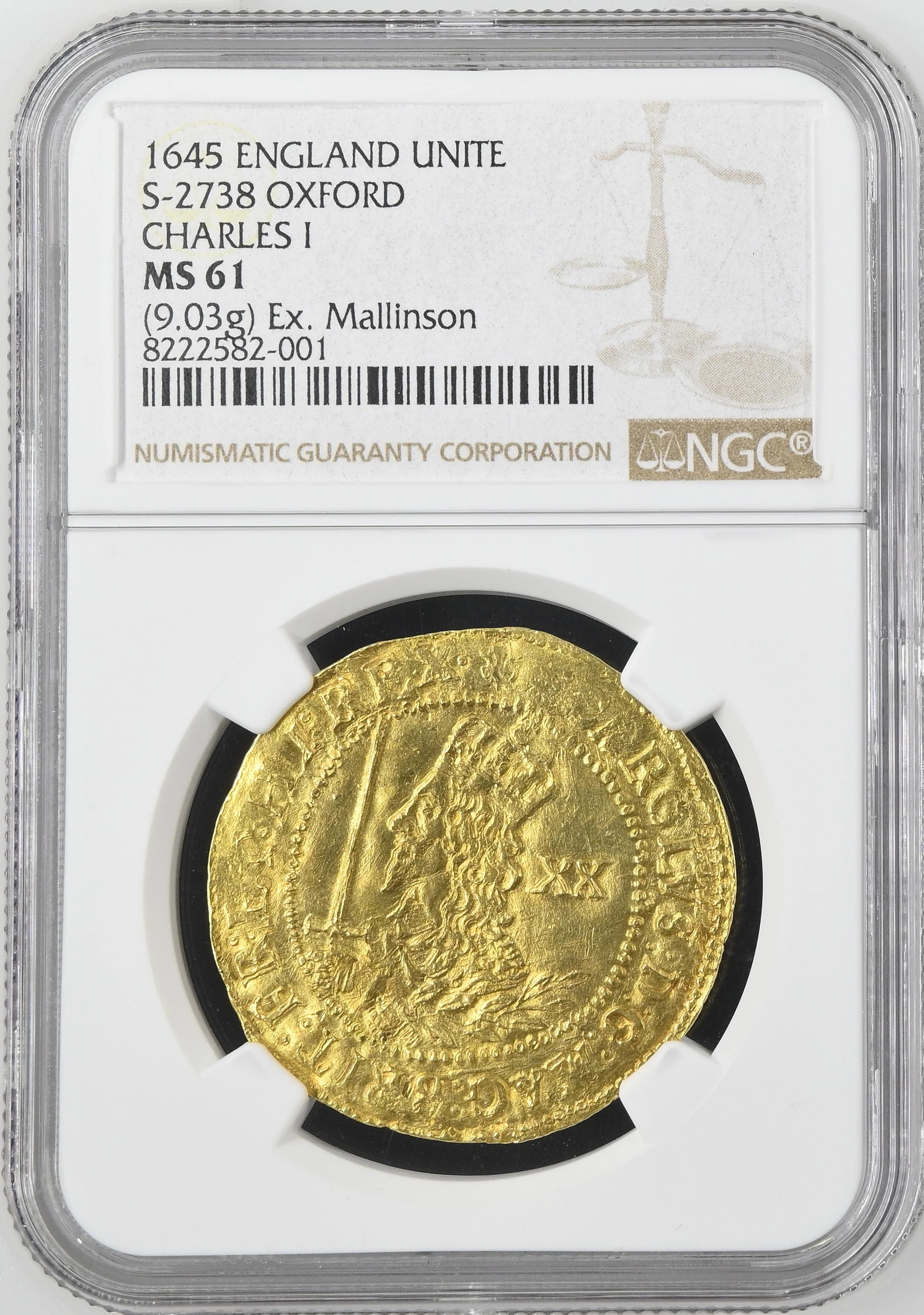
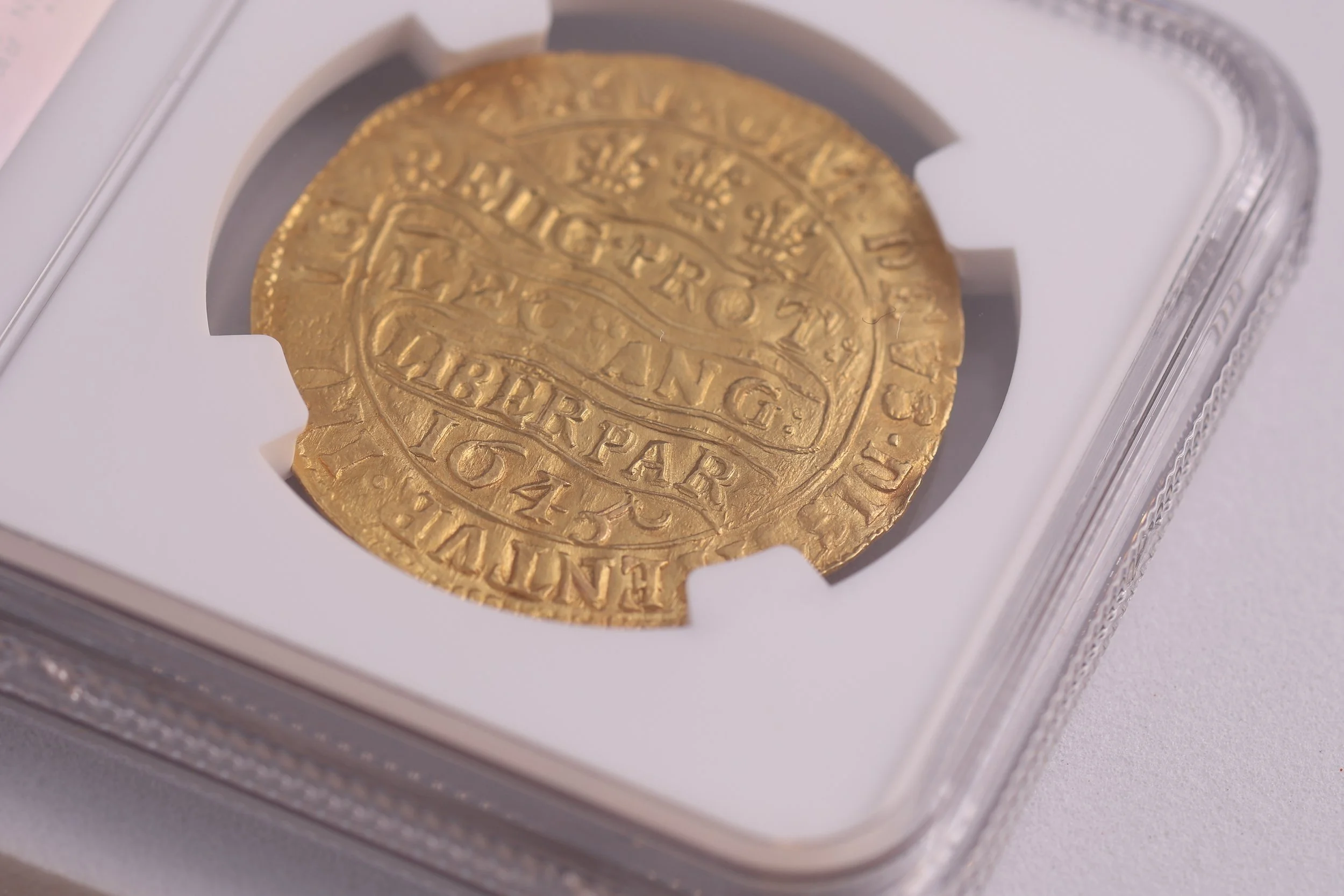
The finest graded example at NGC
Only 2 other coins with this date publicly traded in the last 20+ years.
Single Finest example of this incredibly rare coin of Charles I. This is one of the highest grades awarded for any Oxford Unite of any year with few obtaining a mint state designation. For 1645 PCGS have none graded and NGC only record one other at AU55.
We can only find 2 examples of any type of 1645 Unites publicly sold in the last 20+ years. Only one of these being of this type with 3 plumes (the 3 plumes signify the Oxford Mint but were later removed and a single plume used).
The gold ‘Declaration’ Unites, valued at 20 Shillings, were produced at a time of duress, when the King had moved his Capital from London after the Battle of Edgehill, to the Royalist Universities of the City of Oxford, where he made a state entrance on 29th October 1642. The Mint worked at New Inn Hall. These Twenty Shilling gold coins were struck for five consecutive dates, 1642, 1643, 1644, 1645, and 1646 with a number of variations in obverse and reverse dies, which were most fully defined by R Duncan Beresford-Jones in his article "The Oxford Mint 1642-46 Unites and Half-Unites" in volume 28 of the British Numismatic Journal dated 1955 - this coin is XIII/19.
These coins were produced in small numbers primarily for propaganda purposes perfectly demonstrated by Charles holding both a sword and an olive branch.
Much like the larger triple unite these coins were produced in small numbers. The reason for this is two fold. Gold was hard to acquire, indeed by 1645 with the writing seemingly on the wall for Charles it would appear gold supplies had all but dried up - though in the chaotic state of the civil war there are no remaining records. They were also used to curry favour with the most ardent and wealthy supporters.
The survival rate of these coins is also incredibly low. It is estimated that there are only around 250 triple unites in existence and it would appear that there are only a similar number of unites (half unites are rarer still) though only an incredibly small number are in mint state. It has to be assumed that after the Parliamentarians prevailed any association with the Royalists and the King would have put the owner in peril so most were melted down leaving an exceptionally small supply today.
Features King Charles I on the obverse and a declaration supporting Protestantism, English laws, and parliamentary liberty on the reverse
These coins prominently featured an abbreviated version of the King's Wellington Declaration on their reverse, which stated: "The religion of the Protestants, the laws of England, and the liberty of Parliament" (in Latin: RELIG PROT LEG ANG LIBER PAR). This declaration was a political and propaganda tool, emphasising Charles I's commitment to these principles during a time of conflict
The year 1645 was significant for the Oxford Mint and the English Civil War due to several key developments:
Decline of Royalist Power: By 1645, Charles I's position weakened significantly. The campaigns of this year, including the Battle of Naseby (June 14), marked a turning point, with the Parliamentary New Model Army decisively defeating Royalist forces.
Reduced Coinage Output: The Royalist decline impacted the Oxford Mint's operations. There was a noticeable reduction in gold coin production, including Unites, as resources dwindled and the Royalist hold on territory eroded.
Siege of Oxford: In May 1645, Parliamentary forces besieged Oxford, disrupting Royalist activities. Although the siege was abandoned later, it reflected the increasing pressure on Charles I's headquarters and disrupted the production of coinage.
About: Charles I
Charles I's reign (1625-1649) was defined by escalating tensions between the Crown and Parliament, culminating in the English Civil War and his eventual execution.
Inheriting the throne from his father, James I, Charles shared his belief in the divine right of kings, leading to frequent clashes with Parliament over issues of finance and royal prerogative.
A key event was his repeated dissolution of Parliament when it refused to grant him funds, most notably during the period of Personal Rule (1629-1640), also known as the "Eleven Years' Tyranny," when he ruled without Parliament. This period saw the implementation of unpopular policies, such as ship money, a tax levied without parliamentary consent, further fueling discontent.
Religious tensions also played a significant role, with Charles's support for High Anglicanism, viewed by many as too close to Catholicism, alienating Puritan factions within England and Scotland. This religious friction contributed to the outbreak of the Bishops' Wars in Scotland, which in turn forced Charles to recall Parliament to raise funds, ultimately leading to the Long Parliament and the outbreak of the English Civil War.
The English Civil War (1642-1646 and 1648) was the defining event of his reign, pitting the Royalists (Cavaliers) against the Parliamentarians (Roundheads). The war resulted in Charles's defeat and subsequent trial and execution for treason in 1649. His execution was a momentous event, marking the first time an English monarch had been publicly executed by his own people, and it led to the establishment of the Commonwealth under Oliver Cromwell. Unlike his father, whose reign saw a relatively peaceful transition and avoidance of major conflict, Charles I's reign was marked by constant conflict and ultimately led to the overthrow of the monarchy. His reign had a profound and lasting impact on English history, ushering in a period of republicanism and fundamentally altering the relationship between the Crown and Parliament.