
Beyond the Mintage: A Guide to Conditional Rarity
In the world of numismatics (coin collecting), you often hear the word "rare" thrown around. A novice might look at a mintage report, see a low number, and assume they’ve found a treasure or conversely you may find a common coin and assume there is no value. This myth is further perpetuated with reports of a ‘rare’ coin (often a 50p in the UK) for sale on ebay for an extortionate sum when in reality it is just a chancer hoping someone will pay thousands for something that is actually worth face value. However, as with many aspects of numismatics and investing the answer is often more nuanced. Today we explore: Conditional Rarity.
Conditional rarity is the phenomenon where a coin is common in circulated or average grades, but becomes vanishingly rare in high "Mint State" (MS) conditions. It is the reason why one gold Sovereign might be worth its weight in bullion, while another—seemingly identical to the untrained eye—sells for thousands of pounds.
The 70-Point Revolution
To understand conditional rarity, you must understand the Sheldon Scale. In modern numismatics, coins are graded from 1 to 70. The difference between a consecutive Mint State grade is a matter of a few microscopic differences - usually unseen to the naked eye. For any given coin you will find a ‘spread’ of grades (say from 61-66). What everyone wants is the ‘outliers’ - the single example in 67 (in this instance).
While these differences are tiny, the value curve is non-linear. As you approach the top of the population report ("Top Pop"), the price doesn't just increase—it explodes.
Why Does Conditional Rarity Happen?
There are several different reasons that a coin gets damaged but we need not go too deep into this. The important consideration is that the majority of coins were designed to be used. Either for circulation (paying for items) or for investment purposes (precious metal stored for their intrinsic value) - neither of these means a coin needs to be cared for.
This means that finding a near perfect example of any coin but the most modern is a much greater challenge than finding a poor condition example.
Case Study: The "Gillick" Sovereigns
A classic example of this is the Elizabeth II Sovereign featuring the "First Portrait" of Elizabeth by Mary Gillick. Struck over several years, these coins were produced in relatively high numbers. However, the Gillick design is famously low-relief.
Because the design was so shallow, the "high points" of the portrait—such as the detail in the hair and the delicate facial features—were easily worn or poorly defined during the striking process. Today, while you can find Gillick Sovereigns with ease, finding one in a "Top Pop" grade—pristine, with full luster and no flat spots—is a hunt for a needle in a haystack. That high-grade survivor is a Conditional Rarity.
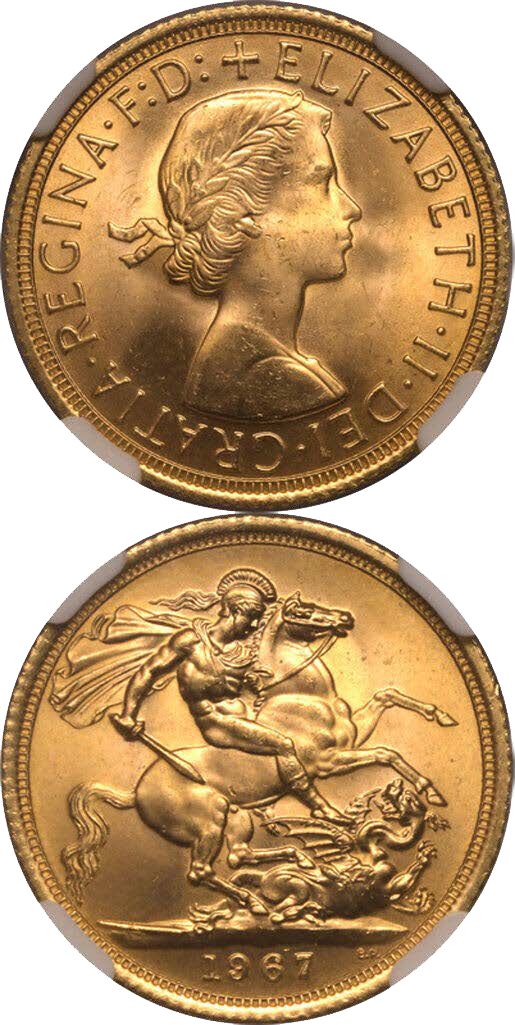
1967 Sovereign in 67 Grade
To demonstrate this at the extreme we can look at the 1967 British Sovereign. This is not a rare coin with circa 5 Million produced. This specific example is the single finest known example and therefore has great rarity. It is graded 67 and sold for £15,808 (including fees) at a September 2023 auction. In the same sale, a Sovereign of the same year graded as 66 (just one grade lower) and one of 20 known examples in that grade, sold for £1,033. This stark difference underscores the critical importance of grade in coin value (and by association rarity), further amplified by the prestige of owning the finest known example.
The "Scarcity Monopoly"
When you own a coin that is "SINGLE FINEST" on the population reports, you hold a scarcity monopoly.
In a standard rarity scenario, the coin is rare because so few were made. In a conditional rarity scenario, the coin is rare because of the low survival rate in high grades and at the extreme you have the best version in existence. For the world’s most competitive collectors, owning the "second best" simply isn't an option. This "battle for the best" is what drives the incredible price premiums at auction.
Is Conditional Rarity a Safe Investment?
Predicting the future of conditional rarity requires a blend of data and foresight. The risk is "Grade inflation”; if a hoard of pristine coins is discovered and graded tomorrow, your "one-of-a-kind" might suddenly have five competitors. But with most coins produced in the last few hundred years the risk is low and at worst maybe one example pops up now and again.
However, for iconic designs and historically significant years, the demand for quality is insatiable. With many coins the gold price provides a "floor" for the asset, and conditional rarity provides the "ceiling"—and in the current market, that ceiling is higher than ever.
Key Takeaways for the Strategic Investor:
Don't trust the mintage: Always check the Population Report.
Focus on the "Pop Drop": Look for coins where there is a massive drop-off in numbers between one grade and the next.
Aesthetics matter: A high grade is great, but "eye appeal" (the subjective beauty of the coin) also has a place.
At Heritatum, we specialise in identifying these "diamonds in the rough"—coins where the condition creates a level of rarity that the broader market has yet to fully price in.
Important Information & Risk Disclosure
The content provided by Heritatum is for informational and educational purposes only and does not constitute financial, investment, or tax advice. Rare coins are tangible assets and should be viewed as a long-term diversification strategy rather than a traditional liquid investment. Tax treatment depends on individual circumstances and may be subject to change. We recommend consulting with a qualified tax professional